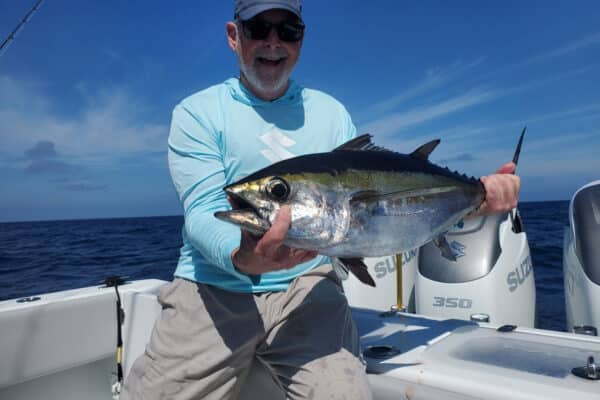
Keep currents in mind—which means keeping bathymetrics in mind—and you’ll catch more fish.
We’re sure you already know that SST is epically important for finding pelagic fish with satellite charts, but SST shouldn’t be considered alone. Naturally, you’ll also be taking a peek at chlorophyll. And, if you have a seriously good satellite fishing service (yes we’re tooting our own SatFish horn, here!) you’ll also be looking at how these things interact with the bathymetrics of any given area. Now let’s add currents to the mix.
Eyes Wide Open
Many people fail to pay close attention to the currents on the charts, sometimes because they fish in areas where the currents tend to be more or less the same all the time and other times because they aren’t sure how to effectively apply the data to their plan. Either way, you should still take the time and effort to click the button and give it a peek.
First off, even the most reliable currents do change and shift from time to time. And a slight push in one direction or another can mean the difference between moving water hitting structure, or not. Secondly, you can spot the specific areas where currents are strongest. Take a gander at these screenshots, first looking at the upper one. The current hits the tip of a bathymetric finger circled in red, and that’s where we hovered our cursor. Note that up top in the center, the grey box at the end of the color-coded current speed bar reads 0.27 kts. Now look at the lower image, showing a similar finger a few miles farther out. When we hovered the cursor over this one, the current showed a meager 0.13 knots—less than half the strength.
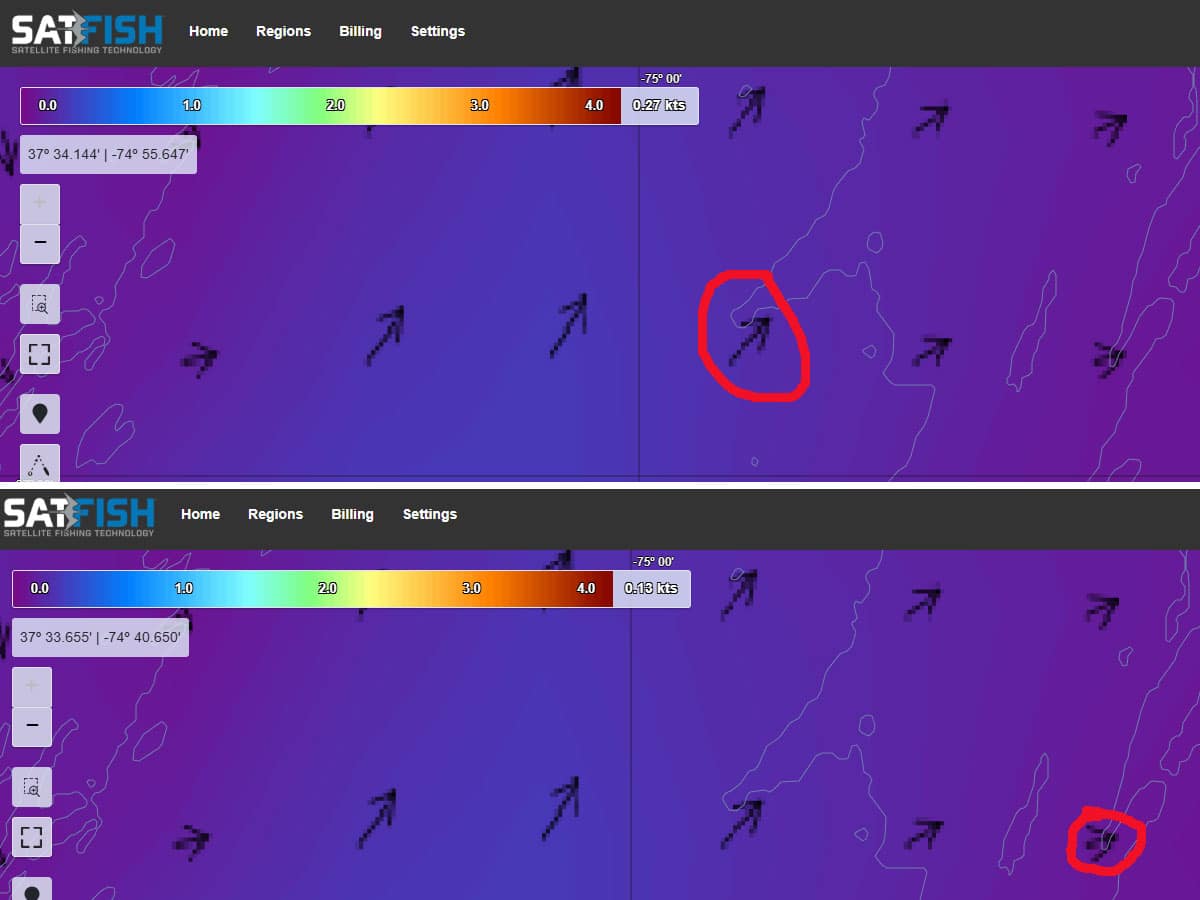
Now let’s say for the sake of argument that we toggled over to the SST charts and there’s a beautiful temp break sweeping equally across both of these fingers. Knowing where the current’s twice as strong, you head for the finger in the top image. But if you hadn’t looked at these images in the first place you may well have plotted in the finger in the lower image. And as a result, you may have cruised right past the better fishing spot without even wetting a line.
Sudden Impact
Another reason to marry currents with bathymetrics is that it can help you ID areas where a strong current creates an upwelling. When you see those arrows indicating a current’s direction look for areas where a strong current collides headlong into a rise in the bottom. The stronger the current is and the more abrupt the rise is, the better. Water smacking into the structure is redirected, potentially creating that classic bait-attracting upwelling that we’re all hoping to find.
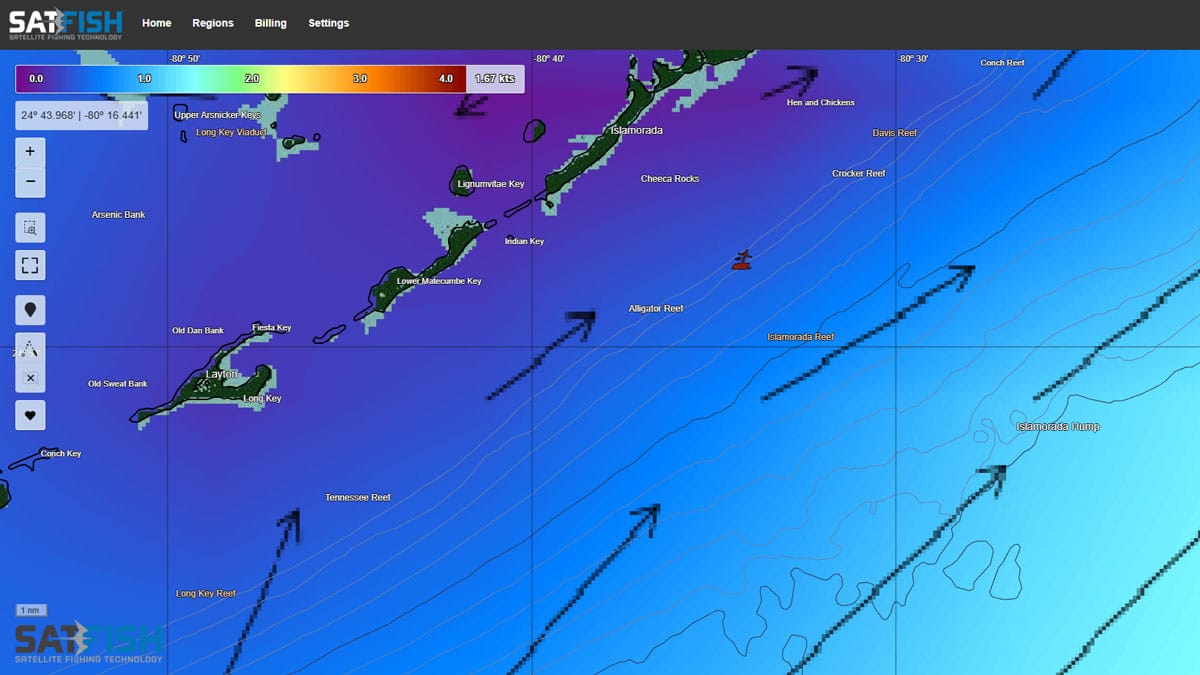
Not coincidentally, quite often you’ll notice that some of the factors we’ve been talking about match up quite nicely with what you see on the SST charts. Areas where the current is stronger, and where it smacks into structure, are often visible to some degree in one form or another (though not always) on the temp charts. It’s not at all uncommon to toggle back and forth between the screens and see a lot of similarities. And spots where you see the most similarities—a hard temp break with a strong current bashing into an underwater mound—are most likely to hold the fish.
Tactical Response
Okay: You’ve spotted the hotspot, arrived on the scene, and deployed the lines. Is that the end of the story? Not entirely. Bear in mind just how strong those currents were in that specific area, because it can have a bearing on what speed and direction of troll will prove most effective. As a general rule of thumb fish swim into a current to gain better control, just as a trout always faces upstream and an airplane always lands heading into the wind. Sure, fish change direction and yes, a strong wind can change the direction of current at the surface. Still, all other things being equal it’s often best to troll into or across a current rather than with it.
If you’re working back and forth across a specific area pay attention to speed, too. Your speed, and thus how hard those baits are swimming, can change quite a bit as you switch directions and go against, with, and across the current. Now throw a stiff breeze into the mix. If you don’t adjust the throttles to account for these environmental factors those baits might swim mightily as you go in one direction, and drag like dead sticks as you go in the other.
This is a lot to keep track of. And in reality it’s just a sliver of a fraction of all the stuff you need to keep in mind to be successful offshore with any semblance of reliability. But we know you’re going to file this all away in the gray matter and come back for more. Because you want—you need—to get those decks bloodied up asap. And checking on the currents will help.