Understanding these key traits of yellowfin tuna will help you catch more of them.
We anglers are forever trying to get into our quarry’s head to figure out where those fish will be and how to catch them. And unsurprisingly, the best anglers are usually those who have the experience and wits to predict, at least to some degree, the where and the how that’s going to work. There are some rather simple, straightforward tidbits of knowledge most of us latch onto—find the bait and you’ll find the fish, match the hatch, and so on—but the true highliners have a lot more intel packed into their heads. And understanding the science behind why a fish does what it does is a critical factor to have in your gray matter.
Yellowfin Tuna and Temperature
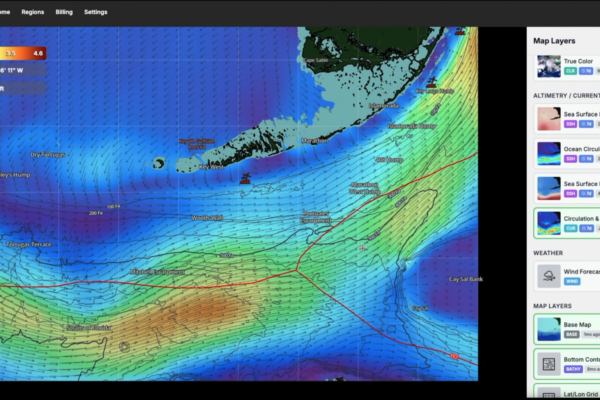
Temperature is one of the most important factors to wrap your head around, so let’s start there. Yellowfin can tolerate anything from the low 60s to the upper 80s, but water temps in the 70s are a sweet spot. Of course, if there’s a horde of bait in 68-degree water along a break with 70-degree water, you can guess there’s a good chance of catching fish on the cold side even though the tunas might actually prefer to be in the warmer zone. Water outside of their broader preference range, however, will rarely prove productive. When you look up the SST on SatFish and see 91- or 92-degree water all over the place, the best bet might be to switch gears and try deep-dropping.
When working inside of the tuna’s preferred range, the specific temperatures of breaks are less relevant and the temperature barrier as a form of structure becomes a lot more relevant. When you see a 72-to-74, for example, it’s a craps shoot as to whether the fish will be on the cooler side or the warmer one, and the presence of additional factors like bait or sargassum is a better indicator than specific water temp.
Of course, water temps at the surface don’t mirror those down below. As a rule, the deeper you go, the cooler it gets, and there will be times and places where the SST reads over 90, but you can still jig or chunk yellowfin up from the depths. So when the surface temps are bumping up against the extremes, keep an eye on the meter for thermoclines and deep marks.
Yellowfin Tuna and Water Color
Anyone who measures their tuna fishing experience in decades rather than years has had the experience of catching fish in surprisingly dirty water. It’s not uncommon to find an SST break, then flip to the chlorophyll concentration maps and note an abrupt change right along the same break. When you get to the spot, you might see dirty green water here and beautiful blue water there—but don’t be shocked if the hookups come when the lures are in the dirty stuff.

Yellowfin do prefer clear water, but their eyesight is such that they can hunt perfectly well in dingy stuff. You’ve undoubtedly heard that they have great vision. But it’s really, really great—a yellowfin’s eyes have spherical lenses which allow underwater focus and twin-cone retinas adapted to the blue-green wavelengths of oceanic water. They can detect UV light, are excellent at spotting contrast, and while studies have shown it’s bluefin tuna that lay claim to having the best lens optics and sharpest focus of any vertebrate, yellowfin aren’t far behind them. What looks like icky, low-vis water to us humans may well present zero deterrence to the yellowfin. So, never let water color or clarity keep you from probing both sides of a break equally until the rods start going down.
Another factor to consider in varying water colors is the color of your offerings. While any particular color pattern, skirt, or lure can prove best on any given day, it’s always a good move to make sure you have something in the spread that matches the water color. In blue water, blues often turn out to be the winner, in green water lime or chartreuse can be a killer, and in purple water purple or pink regularly produces. This has less to do with the tuna themselves and more to do with their prey, which is naturally trying to blend in with the environment. Regardless, keeping this in mind will help you catch more fish.

Note: When you know actively feeding yellowfin are in the area, and you aren’t getting bites, that killer eyesight may well be to blame. Dropping leader test and/or switching from mono to fluorocarbon, switching bait or lure style, and changing colors are all good ways to change your luck.
Yellowfin Tuna and Depth
We think yellowfin spend a lot of time at the surface because that’s where we encounter them. But pop-up satellite tagging has shown that they actually spend most of their time around 230’ below the surface during daylight and at around 130’ at night, usually above the thermocline. (Some conflicting studies claim no difference between day and night depth preference, so this could depend on location and/or environmental factors).

However you cut it, the bottom line is that we undoubtedly pull our baits way up high over a lot of fish without tempting them up to the surface. And this is also why the best captains utilize alternative methods (in addition to the biggest teaser of them all, your boat), of pulling them up. A green stick is undoubtedly effective, but also impractical for small recreational boats. A dangler rig run from an outrigger or dipping a bait from a kite can help fill that gap. Running a “poor man’s downrigger” planer line can also work at times, and even if the fish don’t attack the offering you put behind it, those that come to investigate may home in on your other offerings at the surface. The number-one way to attract those fish, however, is probably the use of birds (the triple Green Machine bird rig is an utter killer) and spreader/splash bars. Don’t leave home without ‘em.
Learn why the fish does what it does. Remember why it goes where it goes. In the long run you’ll catch a lot more of ‘em. Consider water temps, clarity/color, and depth—and put that gray matter to work.